
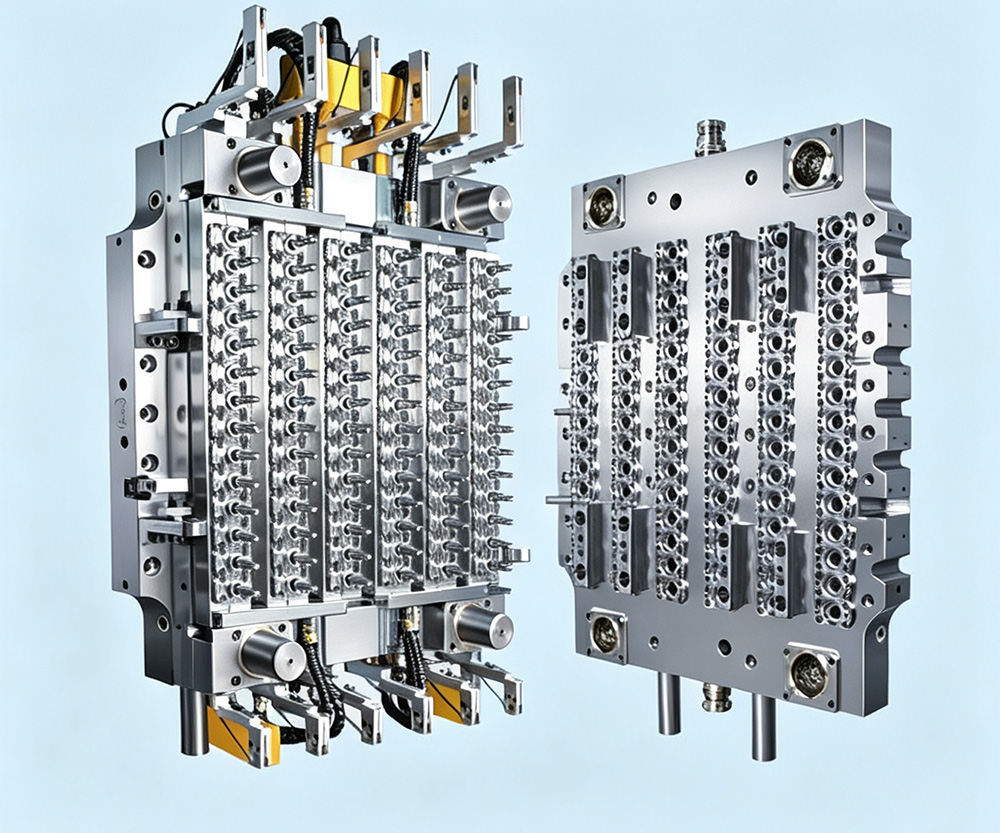
Hot Runner vs. Cold Runner – Which Preform Mold Is Right for Your Line?
A Comprehensive Comparison for PET Preform Manufacturers
Updated: July 2026 | Reading Time: 8 min
Page Summary
Choosing between a hot runner and a cold runner system is one of the most critical decisions in PET preform injection molding. This article provides a comprehensive technical comparison of both systems, analyzing their impact on material waste, cycle time, part quality, initial investment, maintenance costs, color change flexibility, and production volume suitability. Drawing on industry expertise from leading sources including Husky Technologies, MHT, and injection molding professionals [citation:1][citation:3][citation:5], we help bottlers and preform manufacturers determine which runner system best fits their specific production requirements. Apex Mould, with 18+ years of focused experience in PET preform tooling, offers expert guidance and custom mold solutions for both hot runner and cold runner configurations.
Introduction: The Critical Choice in PET Preform Molding
Every PET preform manufacturer faces a fundamental decision when investing in new tooling: should you choose a hot runner or a cold runner system? This choice affects everything from your initial capital expenditure to daily operating costs, part quality, and long-term profitability [citation:5][citation:11].
At Apex Mould, with 18+ years of specialized experience in PET preform tooling, we have designed and manufactured thousands of molds for bottlers in over 50 countries. Based on this deep expertise, we offer this comprehensive comparison to help you make an informed decision for your production line.
What Is a Cold Runner System?
A cold runner system uses unheated channels machined into the mold's parting surface to deliver molten PET from the injection machine nozzle to the cavities [citation:1][citation:5]. The plastic in these channels cools and solidifies alongside the preforms during each cycle. When the mold opens, the solidified runner is ejected with the preforms and must be separated, typically through manual trimming or automated degating equipment [citation:1][citation:8].
Cold runner systems are the simpler, more traditional approach to melt delivery. They have been used since the earliest days of injection molding and remain popular for certain applications.
Advantages of Cold Runner Systems
- Lower Initial Investment: Cold runner molds are significantly less expensive to manufacture because they are simpler in design and do not require complex heated manifolds, temperature controllers, or specialized hot runner components [citation:5][citation:8][citation:11].
- Simpler Maintenance: With fewer components and no electrical heating elements, cold runner molds are easier to clean and maintain. Repairs can often be performed in-house without specialized expertise [citation:5][citation:8].
- Faster Color and Material Changes: Because there is no complex manifold system to purge, color changes are quick and straightforward – requiring minimal material waste and downtime [citation:5][citation:8][citation:11].
- Better Suited for Heat-Sensitive Materials: While PET is the primary focus here, cold runners generally work well with a broader range of thermoplastics, including those sensitive to prolonged heat exposure [citation:5].
- Low Technical Risk: Cold runner technology is mature and well-understood, with decades of proven reliability in the field [citation:11].
Disadvantages of Cold Runner Systems
- Material Waste: The runner system generates plastic scrap that must be either discarded, reground, or recycled. In some cases, the runner weight can exceed the part weight, effectively doubling material costs [citation:1][citation:5][citation:11].
- Longer Cycle Times: Because the runner must cool and solidify before ejection, cycle times are extended. The runner typically has greater thickness than the part itself and takes the longest time to cool [citation:1][citation:7].
- Additional Handling and Labor: Degating – separating runners from preforms – requires additional handling, either manual labor or investment in automated degating equipment [citation:1].
- Quality Limitations: Cold runners can cause gate vestiges, surface defects, and dimensional variations. Gates are typically limited to the part's perimeter, restricting design flexibility [citation:1][citation:5].
- Higher Long-Term Costs: While initial costs are lower, the combination of material waste, slower cycles, and additional handling often makes cold runners more expensive over the long term for high-volume production [citation:1][citation:7].
What Is a Hot Runner System?
A hot runner system uses a heated manifold and nozzle assembly to keep PET molten from the injection machine nozzle all the way to the cavity gates [citation:1][citation:5]. The runner channels are completely encased in steel and never exposed to air, with thermocouples and heaters maintaining precise temperature control throughout the cycle [citation:1].
Unlike cold runners, hot runners do not allow the melt to solidify in the runner system. The material remains molten for the next cycle, eliminating runner waste [citation:1][citation:5][citation:7].
Hot runner systems are available in two primary gate configurations: hot tip (thermal gate) and valve gate. For PET preform applications, valve gate hot runners are the preferred choice because they provide clean gate vestiges and enable gate-free, fully automated production [citation:1][citation:4].
Advantages of Hot Runner Systems
- Zero Runner Waste: Because the runner system never solidifies, there is no plastic scrap to discard or regrind. This is a significant advantage for high-volume production and expensive materials [citation:1][citation:5][citation:7].
- Faster Cycle Times: With no runner to cool, cycle times are shorter. The clamp opening and closing stroke is reduced, and the part can be ejected as soon as it is sufficiently cooled [citation:1][citation:7][citation:8].
- Superior Part Quality: Hot runners allow precise control over melt temperature, pressure, and flow. This results in consistent cavity-to-cavity balance, excellent surface finish, and minimized defects such as blush, weld lines, and sink marks [citation:1][citation:5][citation:8].
- Design Flexibility: Gate location is not limited to the part perimeter, allowing engineers to optimize melt flow for critical dimensions and minimize warpage [citation:1].
- Automation Friendly: Valve gate hot runners enable fully automated production with no manual degating required [citation:1][citation:7].
- Lower Long-Term Costs: Despite higher initial costs, the combination of material savings, faster cycles, and reduced labor makes hot runners more economical over the long term, especially for high-volume production [citation:1][citation:5][citation:7].
Disadvantages of Hot Runner Systems
- Higher Initial Investment: Hot runner molds cost significantly more to manufacture due to complex manifold design, heating elements, temperature controllers, and specialized components [citation:1][citation:5][citation:8].
- More Complex Maintenance: Hot runners have many components that can wear or fail. Burned-out heaters, thermocouples, or seals require specialized knowledge to repair. The entire manifold may need to be sent out for cleaning or service [citation:5][citation:8][citation:11].
- Slower Color/Material Changes: The complex manifold system must be thoroughly purged when changing colors or materials, resulting in longer changeover times and some material waste [citation:5][citation:8][citation:11].
- Risk of PET Degradation: PET is sensitive to thermal and mechanical degradation. Improper hot runner design can lead to dust formation, molecular chain decomposition, and compromised part quality [citation:3]. MHT and Darmstadt University research has shown that hot runner design significantly impacts PET degradation and dust formation [citation:3].
- Technical Complexity: Hot runner systems require more sophisticated engineering, process monitoring, and operator expertise to run effectively [citation:5][citation:11].
Detailed Comparison: Hot Runner vs. Cold Runner for PET Preforms
1. Material Waste
Cold Runner: Produces significant scrap. In some PET preform applications, the runner weight can exceed the preform weight, effectively doubling raw material costs [citation:1][citation:11].
Hot Runner: Produces virtually zero runner waste. All material is used for the preforms [citation:1][citation:5][citation:7].
Bottom Line: For high-volume PET production, the material savings of a hot runner can quickly offset the higher initial mold cost [citation:1].
2. Cycle Time
Cold Runner: Longer cycle times because the runner must cool and solidify before ejection. The runner's greater thickness means it is often the slowest-cooling element [citation:1].
Hot Runner: Shorter cycle times because only the part needs to cool. The mold opens and closes faster, and the part can be ejected sooner [citation:1][citation:5][citation:7].
Bottom Line: Hot runners can significantly increase production throughput for high-cavity PET molds.
3. Part Quality
Cold Runner: Gate vestiges are typically visible, requiring secondary trimming. Surface finish and dimensional consistency can vary between cavities [citation:1][citation:5].
Hot Runner (Valve Gate): Clean, virtually unmeasurable gate vestiges [citation:1]. Excellent cavity-to-cavity balance and consistent preform dimensions [citation:1][citation:5].
Bottom Line: For premium beverage brands where preform appearance and consistency are critical, valve gate hot runners are the superior choice [citation:1].
4. Initial Investment
Cold Runner: Lower tooling cost, typically 30-50% less than a comparable hot runner mold [citation:5][citation:11].
Hot Runner: Higher tooling cost due to complex manifold, heaters, controllers, and engineering [citation:1][citation:5][citation:8].
Bottom Line: The higher upfront cost of a hot runner is a strategic investment that pays back through operational savings [citation:1].
5. Maintenance Costs
Cold Runner: Lower maintenance costs. Simpler design, easier cleaning, and can often be serviced in-house [citation:5][citation:8].
Hot Runner: Higher maintenance costs. Requires specialized expertise, and repairs can be complex [citation:5][citation:8][citation:11].
Bottom Line: While maintenance is more complex, Husky's Ultra hot runners are designed for millions of cycles with exceptional longevity, reducing machine hourly costs [citation:1].
6. Color and Material Change Flexibility
Cold Runner: Fast and easy color changes. Simple to purge and clean [citation:5][citation:8][citation:11].
Hot Runner: Slower and more difficult color changes. Requires thorough purging of the entire manifold system [citation:5][citation:8][citation:11].
Bottom Line: If frequent color changes are required, cold runners may be preferred.
7. Production Volume Suitability
Cold Runner: Best for low-to-medium volume production, prototyping, and short production runs [citation:1][citation:5][citation:8].
Hot Runner: Best for high-volume, continuous production where the initial investment can be recovered quickly [citation:1][citation:5][citation:8].
Decision Matrix: Which System Is Right for Your Line?
Based on industry best practices and Apex Mould's 18+ years of experience, here is a practical decision guide [citation:1][citation:5][citation:11]:
Choose a Cold Runner If:
- Production volume is low: Under 100,000 preforms, the initial cost savings of a cold runner outweigh the long-term advantages of a hot runner [citation:11].
- You have a tight capital budget: The lower upfront investment is the primary consideration [citation:5][citation:8].
- You frequently change colors or materials: Cold runners offer faster, easier changeovers [citation:5][citation:8].
- You lack specialized maintenance expertise: Cold runners are simpler to maintain in-house [citation:5][citation:8].
- You are in the prototyping or pilot production phase: The lower risk and cost of cold runners make them ideal for new projects [citation:5][citation:11].
Choose a Hot Runner If:
- Production volume is high: Over 500,000 preforms annually. The material savings and cycle time reductions justify the higher initial cost [citation:1][citation:5][citation:11].
- Material cost is significant: Expensive resins or high rPET content make waste reduction critical [citation:1][citation:11].
- Part quality is paramount: Premium beverage brands requiring crystal-clear, consistent preforms [citation:1][citation:8].
- You are running 24/7 continuous production: Hot runners deliver the throughput and consistency needed for high-volume operations [citation:1].
- You value automation: Valve gate hot runners enable fully automated, gate-free production [citation:1][citation:7].
- You have the budget and technical expertise: The higher initial cost and maintenance requirements are manageable [citation:5][citation:11].
PET-Specific Considerations: Why Hot Runners Dominated PET Preform Molding
The PET preform industry has largely shifted toward hot runner technology for high-volume production. Several factors drive this trend:
- High Cavity Counts: PET preform molds commonly range from 48 to 96 cavities. In high-cavity molds, the runner weight in a cold runner system can be massive, generating enormous scrap [citation:1][citation:3].
- Material Cost: PET resin represents a significant cost in preform production. Eliminating runner waste directly improves profitability [citation:1].
- Quality Standards: Leading beverage brands demand consistent preform quality. Valve gate hot runners provide superior cavity-to-cavity balance and surface finish [citation:1].
- MHT Research on PET Degradation: Research conducted by MHT and Darmstadt University shows that hot runner design significantly impacts PET degradation and dust formation. A properly designed hot runner reduces degradation and extends maintenance intervals [citation:3].
However, cold runners remain relevant for lower-volume applications, prototyping, and operations where color changes are frequent.
How Apex Mould Can Help
With 18+ years of focused expertise in PET preform tooling, Apex Mould offers comprehensive solutions for both hot runner and cold runner systems:
- Expert Consultation: Our engineering team analyzes your production requirements, material usage, and business objectives to recommend the optimal runner system [citation:11].
- Custom Hot Runner Designs: We design and manufacture precision valve gate hot runner systems optimized for PET, with independent temperature control and balanced flow distribution [citation:1][citation:3].
- High-Quality Cold Runner Molds: For applications where cold runners are preferred, we deliver robust, precision-engineered tooling [citation:5].
- Comprehensive Support: From CAD design and mold flow analysis to manufacturing, testing, and after-sales service – all under one roof.
- Global Service Network: Trusted by bottlers in 50+ countries, we provide spare parts, repairs, and technical consultation worldwide.
Whether you are launching a new product line or optimizing an existing facility, Apex Mould provides the technical expertise and manufacturing quality you need to make the right choice.
Conclusion: Making the Right Choice for Your Production Line
The choice between a hot runner and a cold runner is not about which system is "better" – it is about which system is right for your specific production requirements [citation:11].
For high-volume PET preform production, where quality, consistency, and material efficiency are critical, valve gate hot runner systems have become the industry standard [citation:1]. The higher initial investment pays back through material savings, faster cycle times, and superior part quality [citation:1][citation:5].
For lower-volume production, prototyping, or operations with frequent color changes, cold runner systems remain a practical and cost-effective choice [citation:5][citation:11].
At Apex Mould, we are committed to helping you make the best decision for your business. With 18+ years of specialized PET preform mold expertise and a proven track record across 50+ countries, we provide the guidance, engineering, and manufacturing excellence you need to succeed.
Ready to choose the right runner system for your preform line? Contact Apex Mould today for a free feasibility review and expert consultation.
SEO Keywords (comma-separated):
hot runner, cold runner, preform mold, PET preform mold, hot runner vs cold runner, injection molding, valve gate hot runner, preform mold manufacturer, Apex Mould, runner system, PET injection molding, hot runner system, cold runner mold, injection mold comparison, preform tooling, high-cavity mold, mold design, PET bottle preform, hot runner advantages, cold runner disadvantages, hot runner cost, cold runner cost, preform production, PET molding, injection molding runner, hot runner manifold, valve gate system, PET preform tooling, mold maintenance, cycle time reduction, material waste reduction, runnerless molding
© 2026 Apex Mould. All rights reserved.